
Your Organization Has Already Changed
The Strategic Field Guide to Autonomy, Infrastructure, and the New Operating System of Work

Executive Summary
AI is moving from backdrop to backbone. As agentic systems embed deeper into enterprise fabric, leaders must rethink trust, governance, and competitive advantage—fast. The strategic divide now lies not in adoption, but in orchestration.
On the Horizon
AI is transitioning from pilot to production—autonomy is no longer experimental, it’s structural.
Emerging
Agents are no longer assistants—they’re becoming decision-makers. This forces rethinking governance, accountability, and workforce design.
Evolving
The infrastructure race is being reshaped. Winners are shifting from general-purpose cloud to purpose-built, compliance-aware compute.
Emergent
Fragmenting global standards mean AI strategy must be geopolitically fluent and regulatory resilient.
Points of Perspective
Nearsight
Org readiness hinges on fast formation of AI governance, compute resiliency, and deployment maturity.
Farsight
Future-fitness means mastering trust velocity, composability, and infra-as-policy models.
Implications
Redesign organizational operating systems for agentic scale—autonomy, compliance, and trust are now interdependent levers.
The next move isn’t obvious—until it is.
Strategic Thesis
AI is no longer a peripheral experiment—it is becoming the invisible infrastructure of productivity, decision-making, and strategic differentiation. As systems move from augmentation to orchestration, organizations face a structural reckoning: legacy hierarchies, compliance models, and IT architectures are ill-fit for an agent-driven future. The question for leadership is not how to use AI, but how to redesign for it.
Keep scrolling to see our deep dive below on this strategic thesis and action points for founders, SMBs and F500 CxOs.
If you’re a fan of Tomorrow Mornings, you’ll love Finding Future Fit—our new podcast from Prime Origins that explores the systems, decisions, and unlocks shaping adaptive, intelligence-ready organizations.

Our current series, Opportunity Unlocked, spotlights the founders unlocking opportunities that enable the next-generation of companies, innovations, and organizations.
This Opportunity Unlock episode is co-produced in #partnership with MinusOneDB.
On the Horizon
Emerging
AI Agents Scaling in Enterprise Operations
Enterprises are moving beyond copilots. Agentic AI systems—capable of complex, multi-step, autonomous decisions—are now embedded across customer service, finance, IT ops, and strategic planning. These aren’t tools—they are digital actors, rewriting the architecture of decision-making, accountability, and value creation. The operational center of gravity is shifting from humans managing tools to humans collaborating with agents that learn, act, and escalate independently.
Why it matters:
Org: Requires a shift from process ownership to outcome oversight. Most governance models aren't agent-ready—CxOs must define accountability before scale.
Market: Creates space for AI-native startups to outmaneuver incumbents via composability and velocity.
Systems: Demands real-time data access, secure orchestration layers, and dynamic feedback loops.
Strategic Risk: Without clear operational constraints, autonomous agents introduce liability risks, biased actions, and unexpected escalation paths.
System Context: This marks the transition from "AI-enhanced" processes to "AI-directed" systems—changing the rhythm of decision-making and the locus of control.
Org lenses:
Founder: Lean into agents as strategic leverage, not back-office tools—especially in customer ops and internal QA.
SMB: Use agents to leapfrog capability gaps, but pair with rigorous oversight design.
Fortune 500: Must standardize guardrails across business units or risk fragmented autonomy and internal distrust.
Edge Example: Glean’s knowledge agents and Cohere’s Retrieval-Augmented Generation (RAG) systems are powering real-time, cross-departmental action layers.
CxO Insight: The critical choice isn’t whether to deploy agents—but whether to architect trust, autonomy, and control at scale—or let them emerge by default.
Evolving
Enterprise AI Market Maturing Toward Specialized Infrastructure
The AI arms race is moving beneath the surface—into infrastructure. As enterprise spend nears $100B and climbs toward a projected $300B+ by 2030, the winners are shifting from general-purpose compute to purpose-built, trust-anchored platforms. AI-native infrastructure is becoming a competitive moat.
Why it matters:
Org: Standard IT stacks are struggling under the demands of model tuning, data gravity, and low-latency decision systems.
Market: Specialized chipsets (e.g., TPUs, custom ASICs), vector databases, and orchestration layers are now the most defensible layers.
Systems: Software performance is becoming infra-bound—orgs must control their data pipelines, latency budgets, and inferencing costs.
Strategic Risk: Infrastructure investment is hard to walk back. The wrong bet—on models, clouds, or hardware—can calcify org speed.
Org lenses:
Founder: Build infrastructure flexibility into your product—multi-cloud, model agnostic, usage metered.
SMB: Lean on managed infrastructure but own your observability and interoperability layers.
F500: Rationalize sprawl—standardize architecture while enabling local autonomy at the edge.
CxO Insight: Infrastructure is no longer back office—it is your AI value chain. Decisions made today will define your speed, cost, and trust footprint in 2027.
𝗘𝗺𝗲𝗿𝗴𝗲𝗻𝘁
Global Tech Cold War & Regulatory Divergence in AI
The AI landscape is fracturing into competing ecosystems, regulatory stacks, and value systems. U.S. and Chinese models are diverging on openness, privacy, and alignment. Meanwhile, the EU, India, and Gulf states are asserting regional control over data, models, and deployment rights.
Org: Model selection, data storage, and vendor relationships are now geopolitical decisions.
Market: Global go-to-market strategies must account for model licensing, cross-border friction, and sovereign cloud mandates.
Systems: Trust cannot be global by default—it must be regionally modular and policy-aware.
Strategic Risk: The risk isn’t just bifurcation—it’s slow fragmentation. Org strategies that assume global uniformity may drift out of compliance in stealth.
Org Lenses:
Founder: Choose ecosystems early—open vs. closed, global vs. regional, aligned vs. performant.
SMB: Act as bridges—offer compliance-as-a-service, local deployment, or sovereign stack fluency.
F500: Build a geopolitics-informed AI stack: region-aware, compliance-rich, and legally traceable.
CxO Insight: Your AI strategy is now foreign policy. Trust, growth, and resilience all depend on how well you align with (and navigate) the emerging global AI patchwork.
Points of Perspective
Nearsight
What’s Directly in Front of You
Autonomous systems are already influencing decisions, workflows, and customer interactions—but many orgs are underestimating the friction points. The most immediate risk isn’t strategic—it’s operational entropy.
Assign a Chief Intelligence Officer and activate an AI Steering Council: Don’t just govern—accelerate cohesion and direction.
Setup a Realtime Intelligence and Readiness Loop: Map current agent touchpoints, friction zones, and trust gaps.
Strengthen Surface Resilience: Run scenarios and determine failure thresholds—then codify the guardrails.
Tiered Activation:
Founders: Stand up one live autonomous workflow, then measure latency, trust breakage, and ROI delta.
SMBs: Pair a domain lead with an ops technologist to co-design a safe-to-fail intelligence sprint.
F500: Create an Intelligence Operating System that merges policy, infra, and agent behavior in near real-time.
Farsight
What Emerges When You Broaden the Lens
The most profound shifts aren’t technical—they’re architectural. Autonomy forces organizations to rethink what they centralize, what they modularize, and what they delegate to machines.
Org as Ecosystem: Teams will become composers of agent capabilities—not just executors of process.
Trust Velocity as Differentiator: Your speed of internal trust adoption will define external product velocity.
Policy-as-Platform: Regulations won’t just constrain AI—they’ll create strategic leverage for those who design with them.
If you're building, start with autonomy as your interface layer. If you're scaling, structure for composability, not cohesion. If you're defending, traceability is your defensive perimeter.
Watch edge sectors like defense, pharma, and finance—where AI is already making sovereign, high-stakes calls.
Implications
Strategic Imperatives
AI is not just reshaping workflows—it’s rewriting what an organization is. The most resilient CxOs will move beyond tools and platforms to redesign the systems of trust, orchestration, and decision authority. The operating system of your org is now in play.
Introduce the C³ Framework:
Composable Governance: Design policy and decision rights that move with your agents—modular, testable, and role-aware.
Continuous Autonomy: Establish a living system for onboarding, auditing, and evolving autonomous agents—think lifecycle, not launch.
Culture of Trust: Bake transparency, agent explainability, and shared contracts into daily ops—not quarterly reviews.
Three Structural Moves:
Launch a Metagovernance Team lead by the Chief Intelligence Officer that spans compliance, infrastructure, and decision systems.
Form a Composable Autonomy Guild to prototype new interfaces, workflows, and agent behaviors.
Redesign your Intelligence Stack: understand intelligence gaps between human and machine, build for hybrid cloud, edge decisioning, and trust-driven observability.
Playbooks:
Founders: Hold monthly “Intelligence Mapping Sprints” to co-create and test trust flows.
SMB: Start a cross-functional “AI Task Force” focused on risk reduction and speed acceleration. Consider hiring a fractional Chief Intelligence Officer.
F500: Institutionalize an “Intelligence Office” to cultivate internal intelligence assets.
Activation Mode: Run a Monthly Red Team + Postmortem Loop for every deployed agent system.
Blind Spots:
Mistaking governance for gatekeeping—governance should increase velocity.
Designing infrastructure without treating trust and policy as first-class systems.
The most powerful question a CxO can ask right now isn’t “Where are we using AI?”—it’s “What parts of our organization are now autonomous—and what does that make us?”
Every agent you deploy changes not just how your company operates—but what it is.
Clarity at the edge is your advantage.
If the considerations above matter to you, let’s go deeper.
BOOK A PERSONALIZED BRIEFING
Interested in seeing how your role evolves in the C-Suite, see the CxO Field Guide Series: Evolving Leadership for Agentic AI Integration from the CxO Council at Future Insights
This series breaks down the evolving function of by c-suite role in an AI-powered organization, Key toolsets and use cases already in play, Benchmarks for integration and maturity, KPI and risk frameworks that support principled autonomy and operational clarity, Steps to lead with Humane Intelligence and secure your edge with Humane Security.
This Field Guide deep dive produced in #partnership with Future Insights CxO Council.
📰 Dive deep on the latest CxO Insights
As AI shifts from tool to teammate, leadership is no longer about just managing people or systems—it’s about managing intelligence. That’s where HQ (Humane Intelligence) comes in. Because in an autonomous future, the differentiator for leadership isn’t just IQ or EQ—it’s HQ.
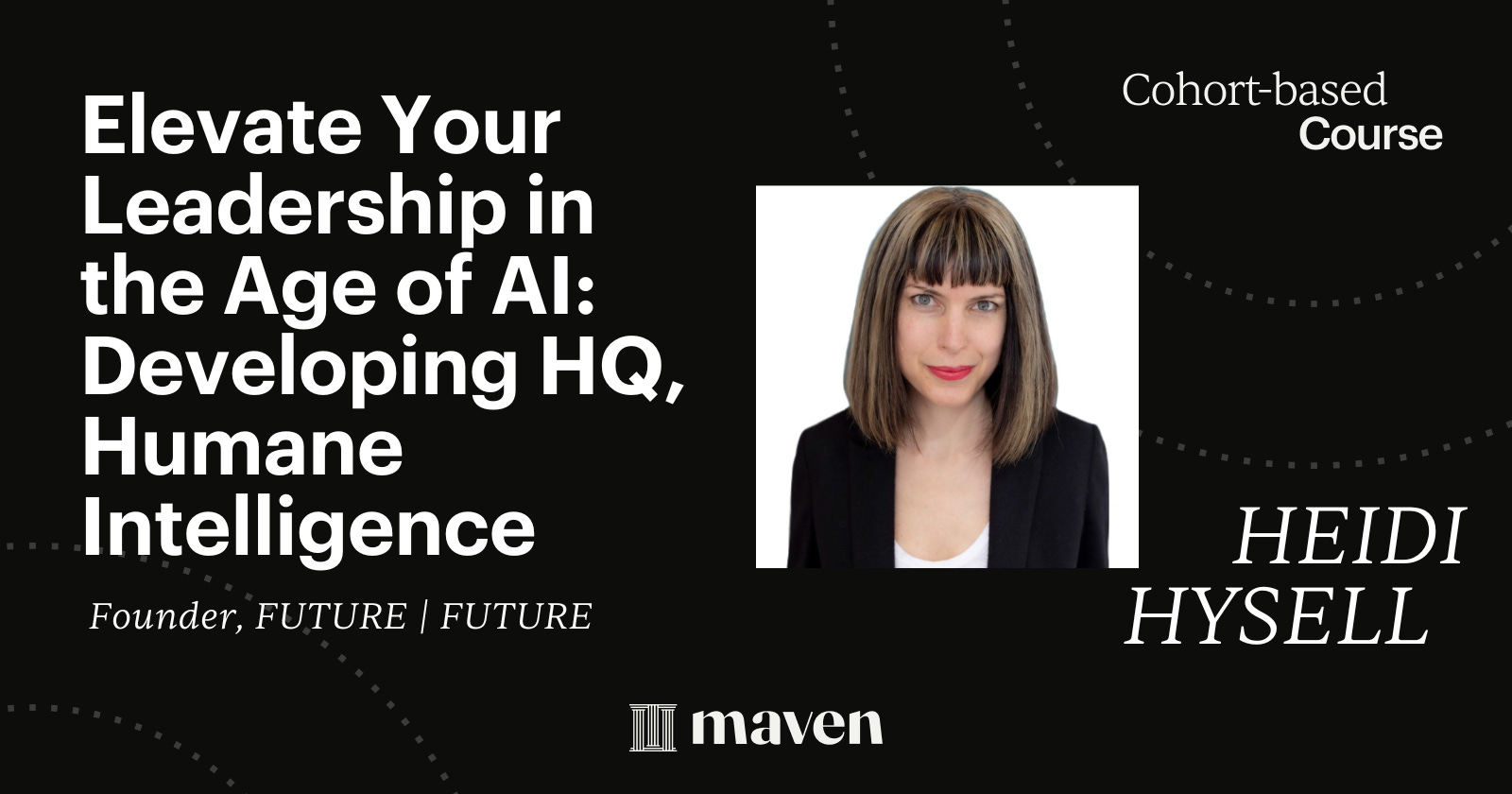
This Maven course helps CxOs build the mindsets and systems to lead in an agentic era. You’ll learn how to design for trust, autonomy, and alignment—across people and machines—and shape a future where intelligence is something we develop in collaboration.